Showing posts with label derelict. Show all posts

Tuesday, 1 April 2014

urbex: The MUNCK building


It's a facinating building and part of industrial history here in Bergen. The building was was abandoned in 2005. The owners moved into more modern and efficient premises. The Bergen Art Academy was supposed to take over the building with 7000 square meeters for the students and their work. But the security of the building was assessed  to be bad, and the costs to secure it was to high. It was left to decay.


 The building is quite functionalistic, but the window works is quite unique and gives the building a touch of Art Deco. The huge windows probably was made to give the workers as much day light as possible.


Sverre Munck started his business in 1924, trading with electrical equipment. In 1949 Munck enteprises buildt their own factory right outside Bergen and became Munck Cranes. The idea was to make electric trolley buses, escalators and cranes.


When Munck Cranes moved out in 2005, the state bought the property. The plan was to demolish the building in 2007 and build a new Art Academy on the property. For some reasons the plans have been stalled and the building is still standing.


The building was designed by the architect Per Grieg (1897 - 1962). Per Grieg was educated an architect in Trondheim in 1922 and set up his own private practice in Bergen in 1923. Per Grieg have drawn and designed numerous monumental buildings and houses in Bergen and the Munk Building is part of his legacy. 


When 'masters' of fine art couldn't work there for security reasons, the graffiti artists didn't care so much about that. This was a perfect space for aerosol masters. The huge space and blank walls are perfect for graffiti.


Homeless people also appreciate a roof over their head.


Rumors tells that now is the time to demolish the building and give space for a totally new building for the Art Academy. Industrial history will vanish, the homeless and the graffiti painters have to find new places to be.

Monday, 3 February 2014

Barrow Gurney : The abandoned asylum

The hospital area from above (Cropped from google maps)
I first saw photos from Barrow Gurney on instagram and my interest for street art and urbex was awakened. I had to go! At arrival only two of the original buildings left, but enough to explore.

In order to prevent over crowding at the existing asylums in Somerset in the 1930s it was decided to build a new mental hospital in Barrow Gurney. Work began in 1934, finnished in 1937 and opened in 1938. The Bristol architect Sir George Oatley designed the the hospital made of red bricks.

In the 60's the hospital's population peaked at 453 patients but numbers began to fall as more provision was made for care at home or by community support workers. 

The abandoned Barrow Gurney Hospital left to decay
Long corridors on several floors to explore
The hospital is not well secured and I had to be careful walking inside
A JPS piece : Freddy
JPS piece with clear reference to Banksy's 'Balloon girl' and of course Stephen King
By 1970 there were about 200 patients in care at the hospital and the number progressively declined until in the 1990s. In 2005 a national survey of NHS hospitals was carried out and Barrow Gurney became famous for being the notorious 'Dirtiest hospital in Britain'. Barrow hospital had particular poor standards of hygiene with "an unacceptably dirty environment". This harsh criticism led to the closure of the hospital. Two of the remaining wards were shut down immediately, and by 2006 the last ward closed it's doors and Barrow Hospital was left to decay.

Difficult to trespass sometimes
Parts of the indoor areas are very dark
Madness and horror (Work by JPS)
JPS (Jamie Paul Scanlon) have during time made several stencils in an on the Barrow Hospital buildings. Some where left when I arrived. Many believes the place is haunted. Jamie have contributed with illustrations that underpin the the creepyness of the place. JPS is based in Weston-Super-Mare near Bristol. JPS have made several street art works similar or inspired by Banksy. In an Interview about the works in Barrow Gurney JPS told "I did not have permission to paint at Barrow however i knew it was going to be demolished and security there very weak so it was a perfect place to make sure I got my work looking right although they still get painted in a very short amount of time I never had any problems although it’s pretty dangerous there. The Settings in which I paint my work is very important to me everything has a place in my eyes." 


I explored Barrow Gurney alone and took in the creepyness and horror of the present and the past and left Barrow Gurney when it was about to get dark.
Good Bye (stencil by JPS)

Thursday, 28 November 2013

The smelting plant

The tag says: 'takk for oss' a norwegian expression for 'good bye from all of us'!
Its about ten years now, since the last workers left the smelting plant in Odda, Norway. The abandoned buildings still stands and reminds us about a tough industrial reality made of concrete and iron. For about hundred years this plant was the cornerstone of a society deep inside the Hardangerfjord, surrounded by high mountains blocking the sunlight.


Destiny, I think, gives me a special relationship with Odda. I've never lived there, but stayed there several times and I think the place is fascinating. The abandoned smelting plant in the middle of town looks like an ancient dark throne of evil forces.


Inside, a carpet of grey sand and dust (probably a mixture of chalk and coal) makes the buildings look like you have entered a colourless post apocalyptic site with dead materials and no life.

   
Once, these buildings where filled with men, dirty and strong men, sweating over melted carbide pouring out of glowing owens. Now, it's cold and hard.


It seems odd to build an industrial smelting plant in Odda, the middle of nowhere, far away from practically everything. In addition there were no lime stone in the area, or coal, the main ingredients in calsium carbide. They shipped the the raw materials to Odda in tankers on the fjord.


In the beginning of the 20th century the reason was an unlimited source of cheap power produced by waterfalls. Calsium Carbide is produced by heating a lime and carbon mixture up to about 2100 degrees celcius. In 1906 the plant in Odda was the biggest Calsium Carbide plant in the world.


Vis større kart

Saturday, 26 October 2013

Queueing for three hours (Tour Paris 13)


Last day in Paris. After a lazy morning, I arrived at Tour Paris 13. Tour Paris 13 is an abandoned apartment block in Paris 13th district by the river Seine. At arrival I saw the big crowd outside the building queueing for entrance. It's a grey and cold Sunday in October and I find my place in the queue.

Tour Paris 13 on the quai d'Austerlitz. Calligraffiti by eL Seed
Tour Paris 13 is an unique exhibition for street art. About hundred international artists have used seven months to paint the building and apartments inside. 4500 square meeters over 9 floors. I would really like to see this.

piece by Tore
The queue moved really slowly and I got to know that they only let 45 people inside at the time. After 1 hour I had just moved some meters.

Dan23 portrait and Elseed Calligraffiti
The organisers believes it is the largest temporary street art and graffiti project of its kind and open for one month, October 2013. The building is planned to be demolished by the end of the year, but there are still people who refuse to move out. After two hours in line, I was starting to loose hope. Two hours to closing time and people around was restless. We began to think that this would not go. Some left, but I decided to stay for a while more. This was my last opportunity to see this during my visit to Paris this time.

After three hours it was beginning to get dark and it began to rain. A security person came by and told that we would not be able to enter before closing time. We were wet, cold and hungry and I realized that I would never see this exhibition inside. I was really disapointed. Can't be lucky every time. I had a good time in the line and learned something important: The project and street art is way more popular than I had anticipated, and I have to plan more carefully around this next time.

Mona Lisa by Inti
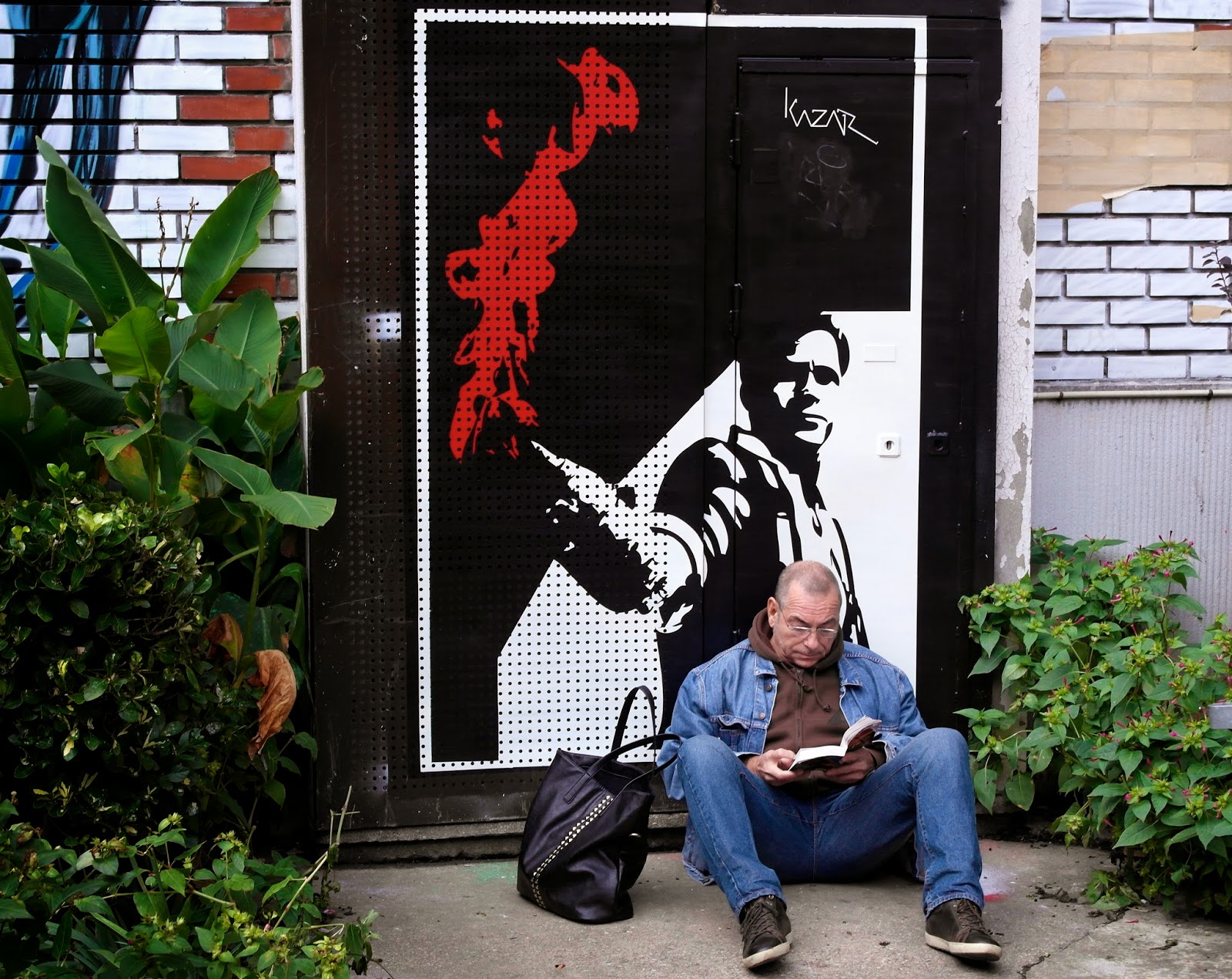
Relaxing on fron of a piece by Kazar
Raiden by STeW


After a while the crowd dissolved and many went dissapointed home that evening. I got a feeling of the project at least and took photos of the works outside.

Monday, 17 June 2013

Derelict and abandoned buildings: A good space for Street Art

FIRST TIME


I first visited the old paint manufacturer a gloomy dark evening in January more than a year ago. The IFA factory on Damsgård is abandoned and left to decline. Couriosity made me take a walk inside for a look.

All factory equipment was removed and big the naked halls was empty and dark. Just pipelines, steel doors and concrete columns was left. The "can artists" had been there! the place was sprayed down with graffiti works. It looked like a practice ground for the graffiti crews. Probably illegal, but not illegal enough to lead to prosecution or fines. Here they could work relatively peacefully and use time to develop their writing and use of color.

SECOND TIME

Second time visit to the abandoned buildings was quite a suprise! During easter time, local street artists had made an inside street art gallery in the old factory buildings. I piecefully walked around and looked at the works. 


It was lovely and the space was perfect!

THIRD TIME

My third time visit i found that most of the street art was tagged or destroyed by vandals with cans. A small scale "graffiti war". There is a conflict in the Bergen area between "spray vandals", between the ones that do street art in the form of figurative stencil and paste-up works and those who do more old time graffiti writing and marker writing. I think that the street artists had moved in to wrong territory this time.


At this moment they are tearing down the old factory building and the spray can vandals are gone. For a short time the abandoned building had served as a graffiti and street art gallery. I think abandoned and derelict buildings serves well as a presentation space for graffiti and street art. A kind of "popup gallery" for a limited time, curated by the street artists them selves.