Wednesday, 12 February 2014

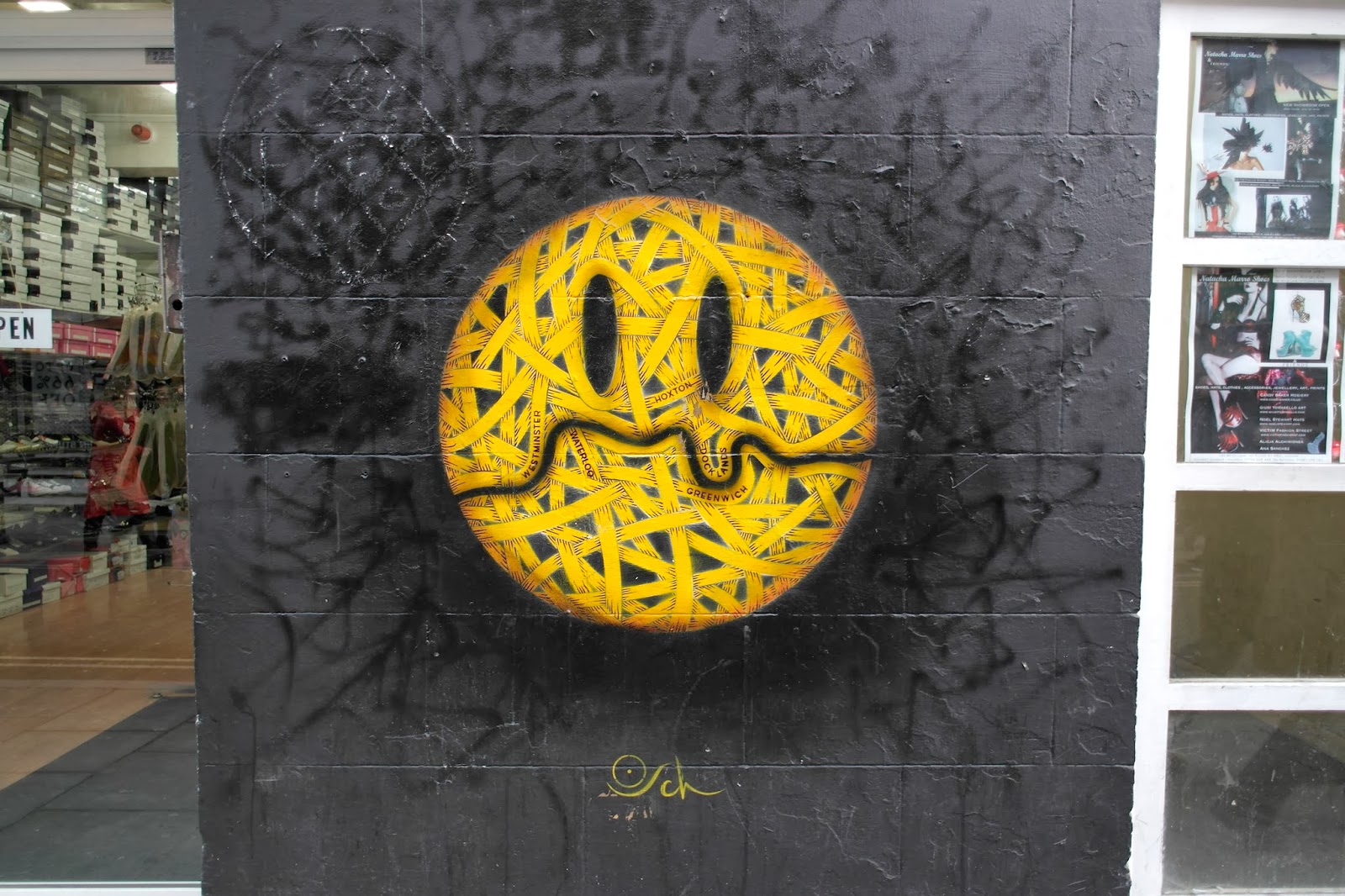
Osch aka Otto Schade: Experimenting in The Streets

"I'm motivated by the idea of producing something interesting, different 

and unique, experimenting with shapes and materials" 

(Otto Schade).


Osch aka Otto Schade  is a multicreative artist with a successful career as an architect and a surreal painter and sculptor, so what the hell is he doing vandalizing the streets of London with graffiti?


Otto Schade, a german sounding name, is born in Chile in 1971 and live and works in London. I've only seen his work in the streets of London, and yes, he have an unique style developed over years and his stencils, somtimes simplistic and sometimes so complicated, both in shapes and colours. He uses warm and bright colours, and therefore easy to spot and recognize.

Surreal street art
A simple and small, but great stencil found in London
 So why do a relative aknowledged and award-winning artist work in the streets? The reason may be in his combined background as architect, painter and skulptor, doing public installations. Doing street art is an environmental act, transforming the the city aesthetics and challenge our minds. Doing street art nowadays is also a great way to get publicity as an artist. In Shade's words "I'm not sure where I'm going with this, but I think the path is the exciting thing and not knowing where my work is going makes me happy. I think recognition from people is an important thing I am looking for,...." On my last trip to London, I found several of his more simple, but ingenious circle formed stencil works which I will call "The Innocence and the man made danger" series of some I post below:


Please visit Otto Shade's website here!

Monday, 3 February 2014

Barrow Gurney : The abandoned asylum

The hospital area from above (Cropped from google maps)
I first saw photos from Barrow Gurney on instagram and my interest for street art and urbex was awakened. I had to go! At arrival only two of the original buildings left, but enough to explore.

In order to prevent over crowding at the existing asylums in Somerset in the 1930s it was decided to build a new mental hospital in Barrow Gurney. Work began in 1934, finnished in 1937 and opened in 1938. The Bristol architect Sir George Oatley designed the the hospital made of red bricks.

In the 60's the hospital's population peaked at 453 patients but numbers began to fall as more provision was made for care at home or by community support workers. 

The abandoned Barrow Gurney Hospital left to decay
Long corridors on several floors to explore
The hospital is not well secured and I had to be careful walking inside
A JPS piece : Freddy
JPS piece with clear reference to Banksy's 'Balloon girl' and of course Stephen King
By 1970 there were about 200 patients in care at the hospital and the number progressively declined until in the 1990s. In 2005 a national survey of NHS hospitals was carried out and Barrow Gurney became famous for being the notorious 'Dirtiest hospital in Britain'. Barrow hospital had particular poor standards of hygiene with "an unacceptably dirty environment". This harsh criticism led to the closure of the hospital. Two of the remaining wards were shut down immediately, and by 2006 the last ward closed it's doors and Barrow Hospital was left to decay.

Difficult to trespass sometimes
Parts of the indoor areas are very dark
Madness and horror (Work by JPS)
JPS (Jamie Paul Scanlon) have during time made several stencils in an on the Barrow Hospital buildings. Some where left when I arrived. Many believes the place is haunted. Jamie have contributed with illustrations that underpin the the creepyness of the place. JPS is based in Weston-Super-Mare near Bristol. JPS have made several street art works similar or inspired by Banksy. In an Interview about the works in Barrow Gurney JPS told "I did not have permission to paint at Barrow however i knew it was going to be demolished and security there very weak so it was a perfect place to make sure I got my work looking right although they still get painted in a very short amount of time I never had any problems although it’s pretty dangerous there. The Settings in which I paint my work is very important to me everything has a place in my eyes." 


I explored Barrow Gurney alone and took in the creepyness and horror of the present and the past and left Barrow Gurney when it was about to get dark.
Good Bye (stencil by JPS)

Friday, 17 January 2014

Another DOLK work gone

the original Dolk Stencil
A classical Dolk stencil in the streets of Bergen is gone. The drummer boy marching towards a landmine refers to the traditional children brigades in Bergen marching in the streets of Bergen every spring. Loved by many, but also hated because of the noise they make in the streets on weekend mornings.

The stencil, made illegaly, have stayed for years but recently the owner of the building started to cut the piece out of the wall. The owner claims that the reason was to preserve the work, and everybody else thought it was done for economical reasons.

Vandalized and gone!
However, somebody wanted otherwise and destroyed the work with white paint before the the house owner finnished the extraction. A sad, but understandable action. An action against privatization of street art and economical motives for street art theft. Thats the second Dolk piece that disappears from the streets of Bergen lately. See my earlier post on street art theft.

Saturday, 11 January 2014

ESPO: A love letter to Brooklyn


On my trip to New York this time, I planned to spend time in and get to know more about Brooklyn. I started downtown and some of the first things I see are painted words on an old concrete building. I recognize these words as made by Stephen Powers (ESPO).

Powers said ones that a word says more than thousand pictures, and Powers paint words, words that make you think, associate and relate. Earlier on, I've seen his works "Love letter for you" in Dublin.

To media Powers said that the building is “Really one of the ugliest pieces of architecture I’ve ever had the privilege of decorating. It’s just built for vandalism.” Powers got permission to paint the garage. The irony is that Powers have reversed the idea of graffiti as vandalism and says that: 
A neighborhood in decline has always been an ideal place to work. Generally, you are only improving the situation with a little bit of paint, and the work tends to last longer than in the pricey precincts of the city. Now that I’m getting calls to help revitalize areas, it’s not irony; it’s people seeing my work the way I’ve always seen it: as an improvement.
The parking garage belongs to Macy's and the works in Brooklyn was a following up on his A Love Letter for you in Philadelphia and Syracuse. The black and white letters gives the place a vintage and industrial look.

'A love letter to Brooklyn' was largely inspired by conversations he and his team had with people passing by the parking garage. The result are words and small sentences are 'existential' and gives associations to relational issues which is of concern to all of us. In addition to the car garage Powers painted the wall of a sneaker store front on Bond street and Fulton mall, it reads “All I Need Is You And New Shoes”.

Tuesday, 31 December 2013

Happy New Year!

Argus piece in Vestre Skostredet
"If one asks himself what living individual who gives most of the Bergen population's sense of identity, I think (after Herman Friele who has moved out of the town hall) that is the 80 year old Otto. Otto Fredrik Wollertsen had the street as his home for the most of his adult life. Through his daily hunched walks through the city's streets for decades, by bike, cassette player and harmonica, he's become a part of Bergen's soul. And through his choice of life, he has seen the world from the standpoint almost no other know. Therefore, his story uniquely enriching." - Ole Hamre in 2008

Ottoen strolling by a big wall poster on EU leadership

HAPPY NEW YEAR, GOOD PEOPLE!!

Wednesday, 11 December 2013

It's warm inside!


It's warm and cousy inside and December offers just a few hours of light a day. Bergen Street Art (BSA) have moved inside. The Gallery at USF (United Sardines Factory) and BSA have curated the largest assembly of street art works from local artists to date. BSA is a collective or assosiation of artists that promote street art and organizes different activities like workshops, discussions and street art happenings. The exhibition this time was a showcase, and the works was not for sale. 

These artists are usually found in the streets outside, in and around Bergen city. Some of them still active vandals. Others haven't done any interesting stuff in the streets for years.

I'm usually critical to street art inside, even if the artist is Dolk (See the blogpost: 'Wildlife'). And I must say that the 'LEGAL' exhibition was no exception. This art inside becomes toothless and misplaced. If the  exhibition is regarded as presenting the status of street art in Bergen today, I think the status is in no good shape. With a few exceptions, the works do not give much hope for the future, regarding creativity, quality and impact.

My personal faviourites (and few exceptions) in BSA are Argus and johnxc. In addition, I like LaStaa, but would have liked to see more new works from the artist out in the streets.

I like Argus for his productivity and variability, always cutting new stuff and presenting original works. I like the relatively new "tile style". His stencil motives, made up of triangulated tiles in different shapes and sizes, are fresh and I've seen nothing like it in the street art world. Argus is a creative force and I regard him as the leading street artist in Bergen today.

Argus Stencil at USF (outside)
Argus have not found reason to present works on "soft" canvas made for livingrooms yet.
 I love the "Strindberg maniacs" of johnxc. His portraits are figurative, but made experimental with, I think, inflicted madness :-). johnxc often us magazine papers as canvas and paste them up on the wall. I think his style is original and distinctive and he's the only street artist contributing to 'LEGAL' that I could concider putting up on my wall.  johnxc have found a way that actually works both outside and inside.

johnxc work inside at 'LEGAL'
Works from the showcase:

johnxc to the left and stencil 'Salome' by Yatzy to the right

The new king of chess: Magnus Carlsen portrayed by LaStaa


Upper left is the 'The Angry Boy' by LaStaa (inspired by the famous statue of Gustav Vigeland), Bottom Left a stencil by Chris Stain and right, stencil and installation by Habitus

Some of the artist made pieces outside in the USF area, and I think those were the best works presented of BSA 'LEGAL'.

Fisherman portrait by Yatzy
David Hasselhoff on duty by LaStaa
Earlier on I wrote about the 'exhibition' in the old paint factory, and found the abandoned buildings great for street art inside. A perfect venue for BSA, but probably did not reach a large audience and sadly destroyed after brief time by other vandals. USF is a major institution for art, film and music in Bergen, and in this respect a very good venue for showing street art when it comes to reaching a larger audience. That's the biggest achievement of 'LEGAL'. And maybe others, talented, will be inspired to do art in the streets. 

Thursday, 28 November 2013

The smelting plant

The tag says: 'takk for oss' a norwegian expression for 'good bye from all of us'!
Its about ten years now, since the last workers left the smelting plant in Odda, Norway. The abandoned buildings still stands and reminds us about a tough industrial reality made of concrete and iron. For about hundred years this plant was the cornerstone of a society deep inside the Hardangerfjord, surrounded by high mountains blocking the sunlight.


Destiny, I think, gives me a special relationship with Odda. I've never lived there, but stayed there several times and I think the place is fascinating. The abandoned smelting plant in the middle of town looks like an ancient dark throne of evil forces.


Inside, a carpet of grey sand and dust (probably a mixture of chalk and coal) makes the buildings look like you have entered a colourless post apocalyptic site with dead materials and no life.

   
Once, these buildings where filled with men, dirty and strong men, sweating over melted carbide pouring out of glowing owens. Now, it's cold and hard.


It seems odd to build an industrial smelting plant in Odda, the middle of nowhere, far away from practically everything. In addition there were no lime stone in the area, or coal, the main ingredients in calsium carbide. They shipped the the raw materials to Odda in tankers on the fjord.


In the beginning of the 20th century the reason was an unlimited source of cheap power produced by waterfalls. Calsium Carbide is produced by heating a lime and carbon mixture up to about 2100 degrees celcius. In 1906 the plant in Odda was the biggest Calsium Carbide plant in the world.


Vis større kart